How this differs from the 2016 trial
The earlier study followed sustained training for three years in India. This trial examined a shorter intervention in a US public school. It asked whether a commercially provided curriculum, taught in ordinary classrooms, improved computation or broader cognitive measures relative to existing teaching.
The paper appeared online on 30 January 2018 in a journal issue labeled 2017. The article’s published citation uses 2018; that is why this explanation and its URL use that year. The publication year should not be confused with the duration of training.
Classroom randomization and equal teaching time
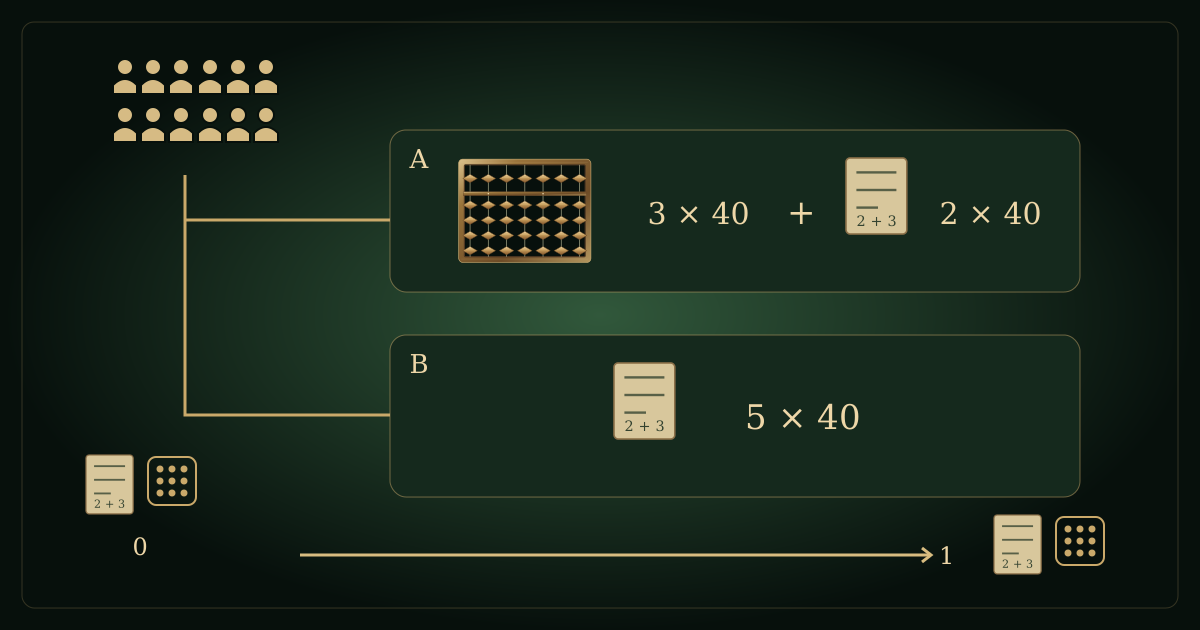
Classes, rather than individual children within a class, were assigned to the two conditions. The comparison classes continued standard mathematics. Abacus classes used three 40-minute periods per week for abacus instruction and two for their usual mathematics; comparison classes used all five periods for their usual curriculum.
Testing took place near the beginning and end of the school year. The researchers assessed arithmetic, place value and cognitive tasks, and also checked whether learners could read abacus arrangements. This distinguishes gaining some familiarity with a frame from showing a wider academic advantage.
Findings: no general computation advantage
Neither grade showed a significant advantage in mathematical computation or the cognitive abilities tested relative to the comparison condition. First graders had more difficulty acquiring abacus expertise; second graders were more successful. There were hints of a place-value advantage among older learners, rather than a broad, established mathematics benefit.
“No significant advantage” describes the evidence from these tasks and this design. It does not show that no child learned, that the groups made no progress, or that every longer program must fail. Equally, an interesting exploratory result should not be presented as a guaranteed benefit.
Ask which comparison is being made
Improving between the beginning and end of a school year is different from improving more than classmates following another curriculum. The second comparison is the central intervention question.
Limitations and uncertainty
The trial concerns one school and one academic year. Participation depended on consent and attendance, and not every child contributed data at both assessments. Teachers knew the teaching condition, although researchers administering the main tests were kept unaware of group assignment.
The findings do not separate training duration from every other difference between this and the 2016 study. Setting, age, curriculum and how instruction fits the timetable also changed. It would be misleading to say that the two papers prove one year never works and three years always does.
Reading both studies together
The two trials offer evidence about particular educational arrangements. They are more informative than testimonials because they compare groups and assess outcomes, but their conclusions still depend on what was tested. A parent can value enjoyable, understandable arithmetic practice while checking claims about wider benefits separately.
When choosing activities, ask whether the child can explain place value and exchanges, whether tasks suit their readiness, and whether the advertised outcome matches the evidence. Sorobak’s free tools let families explore bead arithmetic; neither study specifically evaluated Sorobak.
| Feature | 2016 paper | 2018 paper |
|---|---|---|
| Setting | School in India | US public school |
| Duration | Three years | One school year |
| Assignment | Students | Classes |
| Teaching arrangement | Extra practice in both groups | Same total timetable, different curriculum mix |
| Computation result | Arithmetic advantage | No significant advantage |
| Broad cognitive benefit | Not established | Not established |
Key points to remember
- Random assignment was at the classroom level.
- The abacus program replaced part of usual mathematics time rather than adding extra hours.
- Learning to read beads is different from outperforming another curriculum.
- The article was published in 2018 in an issue labeled 2017.
Sources & further reading
This is an original educational explanation of the research, not the original paper. The full publication is identified below.
- Barner et al. · Journal of Numerical CognitionBarner, D., Athanasopoulou, A., Chu, J., Lewis, M., Marchand, E., Schneider, R., & Frank, M. (2018). A One-Year Classroom-Randomized Trial of Mental Abacus Instruction for First- and Second-Grade Students. Journal of Numerical Cognition, 3(3), 540–558. DOI: 10.5964/jnc.v3i3.106.