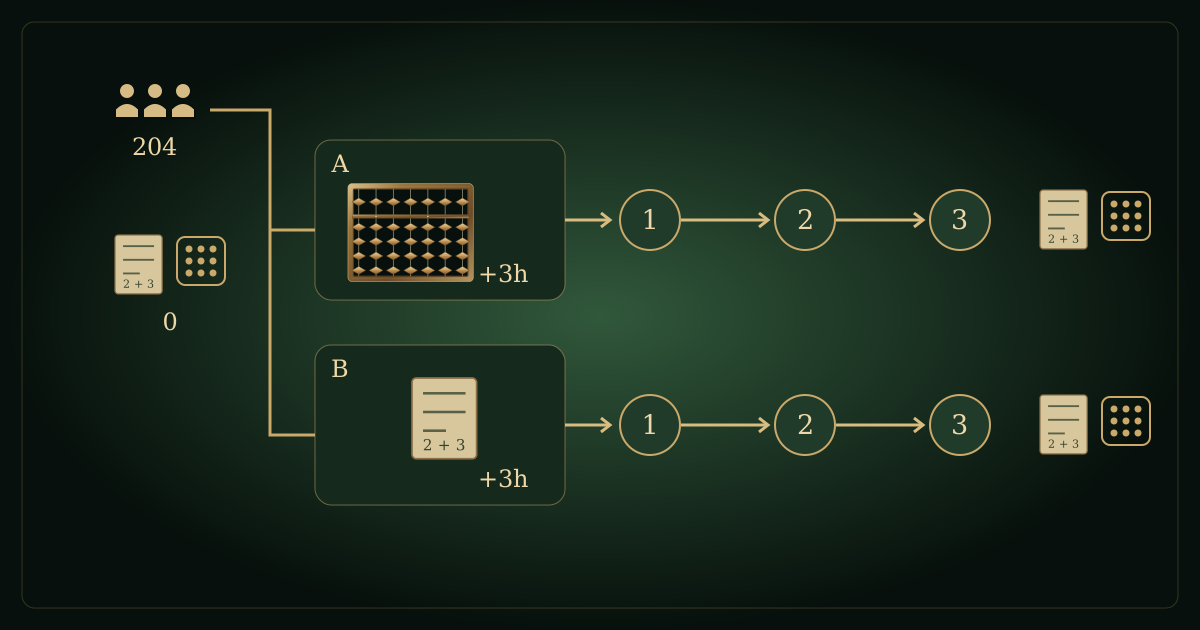
What did the researchers ask?
Mental abacus arithmetic means using an imagined bead arrangement to calculate. Learning usually begins with a visible frame, so that its positions and procedures become familiar. The study asked whether this expertise could develop in a regular classroom setting and whether it improved mathematical performance beyond another form of mathematics practice.
A separate question concerned cognitive transfer: would training also change capacities such as working memory? Working memory is the ability to keep information available while using it. Becoming better at one practiced procedure and increasing a broader capacity are different possible outcomes.
How the three-year trial was designed
The researchers enrolled 204 children, initially aged five to seven, at a school in Vadodara, India. Students were randomly assigned to mental abacus or an active comparison group. Both continued the regular mathematics curriculum and received three additional hours of mathematics instruction each week; the extra instruction differed in its method.
An active comparison matters: the test was not “practice versus no practice.” Assessments before training and over three years allowed the researchers to examine changes in arithmetic and cognitive performance. Random assignment reduces systematic selection differences, although it does not guarantee that the starting groups are identical.
What the study found
The mental-abacus group showed an arithmetic advantage over the comparison group. The study did not establish a general improvement in the basic cognitive abilities it measured. Initial spatial working-memory differences were associated with how successfully children learned the technique.
For a parent, the distinction is practical: learning to manipulate an imagined bead frame may improve the arithmetic being practiced without making every kind of thinking stronger. A group result also does not mean every child improves by the same amount.
Skill improvement and broad transfer are different claims
A child who becomes more accurate on practiced additions has demonstrated arithmetic learning. To claim broader memory improvement, a separate memory task and a suitable comparison are needed.
What the result cannot establish
This was one school setting with a sustained schedule and experienced instruction. Some students left during follow-up, and the groups differed on some mathematics measures before training; the researchers used analyses that considered starting performance. These details matter when interpreting the result.
The trial does not test every age, teaching format or online course. It cannot guarantee results for a particular child or establish that a few introductory sessions reproduce three years of instruction. Nor does an arithmetic advantage establish an increase in general intelligence.
How parents can use this evidence
A useful way to evaluate learning is to ask what the child can now explain and do: read a number, perform an exchange, check an answer or solve an appropriate new example. Keep those observations separate from broad claims about intelligence or school success.
Ask how a course introduces the frame, how often practice occurs, and how progress is checked. These are questions about the actual learning experience, not promises inferred from a paper. The 2018 classroom study provides a valuable comparison because it examined a shorter program in a different setting.
Key points to remember
- The 204 figure describes initial enrollment, not the sample for every analysis.
- The comparison group received mathematics practice too.
- Arithmetic outcomes and working-memory outcomes answer different questions.
- The 2016 and 2018 papers describe different trials, not two reports of the same classroom program.
Sources & further reading
This is an original educational explanation of the research, not the original paper. The full publication is identified below.
- Barner et al. · Child DevelopmentBarner, D., Alvarez, G., Sullivan, J., Brooks, N., Srinivasan, M., & Frank, M. C. (2016). Learning Mathematics in a Visuospatial Format: A Randomized, Controlled Trial of Mental Abacus Instruction. Child Development, 87(4), 1146–1158. DOI: 10.1111/cdev.12515.