What is an abacus?
An abacus is a tool for representing numbers and carrying out arithmetic by moving counters. It may be a board with loose stones, a surface marked with lines, or a frame of beads on rods. The person using it performs the calculation; the device keeps the quantities visible.
The essential idea is place value. A counter in one position can stand for a unit, while a counter elsewhere stands for ten or a hundred. Moving, grouping, and exchanging counters lets a user add or subtract without writing every step. On many bead frames, the same arrangement can represent whole numbers or decimals depending on where the units place is chosen.
Early counting methods included fingers, tally marks, and movable objects. A marked surface added organization: instead of gathering hundreds of stones, a calculator could use positions to represent larger amounts. A counting aid and a bead abacus belong to the same broad story, but they are not necessarily the same instrument.
Who invented the abacus?
No single inventor of the abacus can be identified with certainty. Its origin lies in a long history of arranging and moving counters, with different forms used in several cultures. Surviving objects and written descriptions document particular devices, rather than a named person creating the entire idea.
Ancient Mesopotamia is often discussed as a possible setting for early counting surfaces. However, a precise claim such as “the abacus was invented in one specific year” goes beyond the available evidence. Its history makes more sense as a series of adaptations to local numerals, currencies, and calculation habits.
The abacus in ancient civilizations
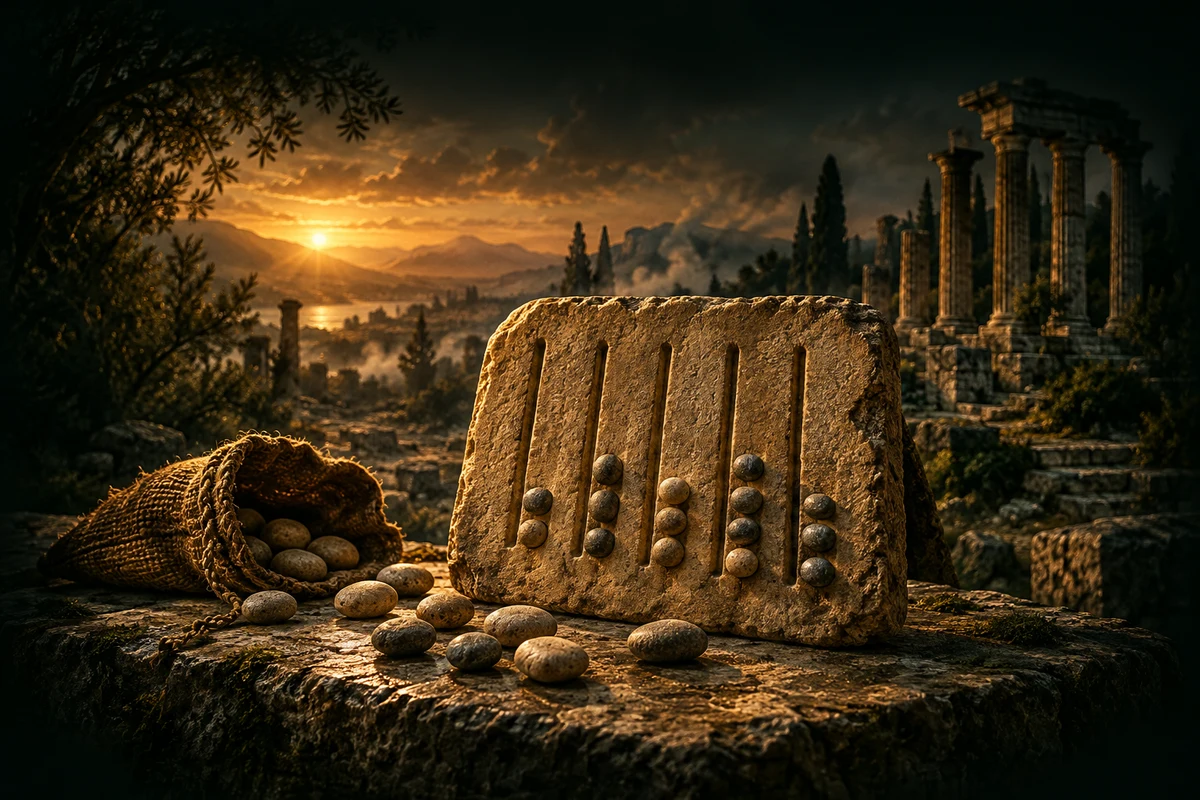
Greek calculation included placing counters on ruled surfaces. The marble Salamis counting board is a surviving example of this tradition. Such boards are important evidence for the ancient abacus, even though they look quite different from a modern wooden bead frame.
Romans also used counting surfaces and portable devices with counters sliding in grooves. Some Roman hand abacuses separated values of five from units and included positions for fractions. This made practical calculation possible alongside Roman written numerals.
Commerce gave these tools a clear purpose: total a payment, compare quantities, or work through an account. They also belonged to the wider world of arithmetic. A useful distinction is between how a number was written and how someone calculated with it; the two methods could be different.
The Chinese abacus — Suanpan
Before the familiar suanpan became widespread, Chinese mathematicians calculated with rods arranged on a surface. This earlier tradition helped shape the bead abacus. The bead frame was well established during the Ming dynasty. The British Museum preserves a porcelain suanpan frame dated approximately 1522–1566, tangible evidence of its use in that period.
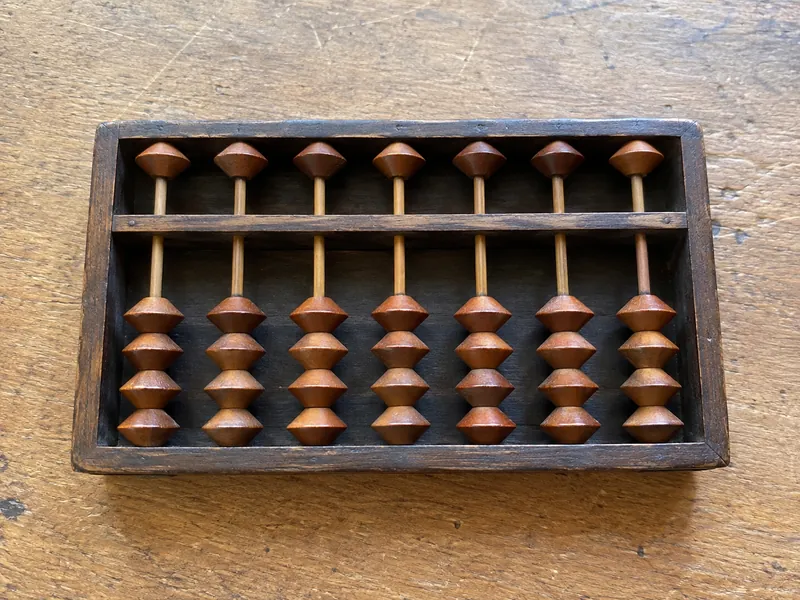
A traditional suanpan has two beads above a horizontal beam and five below it on each rod. Each upper bead counts as five lower beads in the same place. Beads moved toward the beam are counted; those moved away are inactive. Adjacent rods represent successive place values.
For example, one upper bead and two lower beads at the beam represent seven in that rod’s place. In the tens place, the same arrangement means seventy. Extra beads support traditional calculation procedures; they do not mean a decimal digit must be greater than nine.
The associated calculating practice is called zhusuan. UNESCO inscribed Chinese zhusuan on its Representative List of the Intangible Cultural Heritage of Humanity in 2013, recognizing the knowledge and traditions transmitted by its practitioners.
The Japanese abacus — Soroban
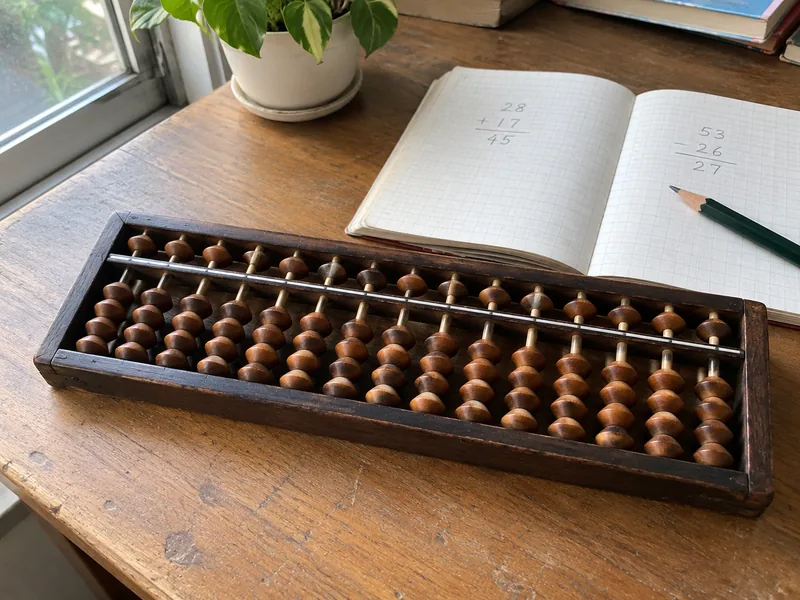
The soroban developed from the Chinese bead abacus introduced to Japan. By the Edo period, it was used by merchants, farmers, and mathematicians. Japanese practitioners adapted its shape and techniques to their own needs, making it a familiar instrument for both everyday accounts and mathematical work.
Japanese soroban history is also a story of simplification. Older instruments could have two upper beads and five lower beads, or one upper bead and five lower beads. During the late nineteenth and twentieth centuries, the modern one-upper, four-lower arrangement became established. There was a transition between designs, rather than an overnight replacement.
On a modern soroban, the upper bead represents five and each lower bead one. Together they are enough to express every decimal digit from zero to nine. For nine, move the upper bead and all four lower beads to the beam. For ten, clear that place and add one in the next place.
Soroban beads are often shaped for quick, precise finger movements. Compared with the traditional suanpan, fewer beads create a compact decimal layout. Both tools use place value, and both depend on learned procedures rather than automatic computation.
The abacus around the world
Russian Schoty
The Russian schoty uses horizontal wires, usually with ten beads on each main wire and no beam dividing fives from ones. Place values run from row to row. Historical examples may include a four-bead row for monetary fractions. The Smithsonian’s Russian abacus collection documents this distinctive layout.
European counting boards
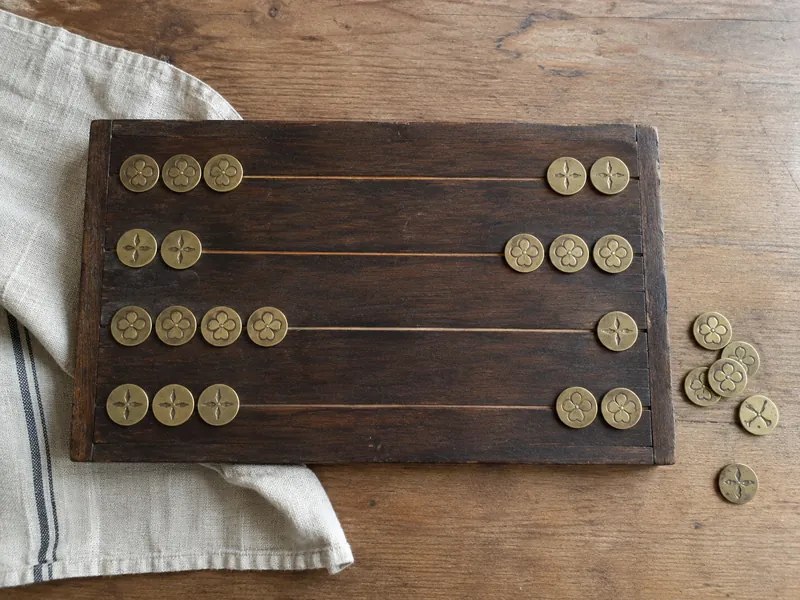
In medieval and early modern Europe, people moved reckoning counters, also called jettons, across marked tables, boards, or cloths. These methods were useful for accounts and money calculations. As written arithmetic became more common, counters continued alongside it rather than vanishing at a single date.
Other counting traditions
Tally sticks and counting sticks also made quantities easier to record or handle. In the Andes, Inka khipu encoded numerical information in knotted cords, including records of taxes and labor. Numerical tools were diverse: storing a total and actively calculating can serve different purposes. A khipu is not a bead-frame abacus, and calling every traditional counting system a soroban would hide those differences.
The abacus in modern education
An abacus gives learners a visible way to explore place value, grouping, and exchanges between units and tens. Moving beads can make an arithmetic step concrete: exchanging ten ones for one ten shows why carrying works. It is most useful when movements are connected to an explanation of the number.
In mental abacus training, students learn to imagine bead positions and manipulate that image to calculate. This is a practiced representation of numbers, not simply memorizing a list of answers. Training usually begins with a physical or onscreen tool before moving toward calculation without it.
Research supports a careful view of the benefits. A three-year randomized study found stronger arithmetic performance in the mental-abacus group without improvement in general cognitive abilities. A shorter classroom trial did not find a general arithmetic advantage. Results depend on the learners and the training; a promise of a universal intelligence boost is not justified.
Digital abacus tools make the same place-value model available on a phone or computer. They can support demonstrations, guided lessons, and practice. The useful educational question remains the same: can the learner explain what each bead represents and why the calculation works?
Suanpan, Soroban, and Schoty compared
These images show traditional bead layouts. Historical examples vary; the linked articles explain how the devices work.
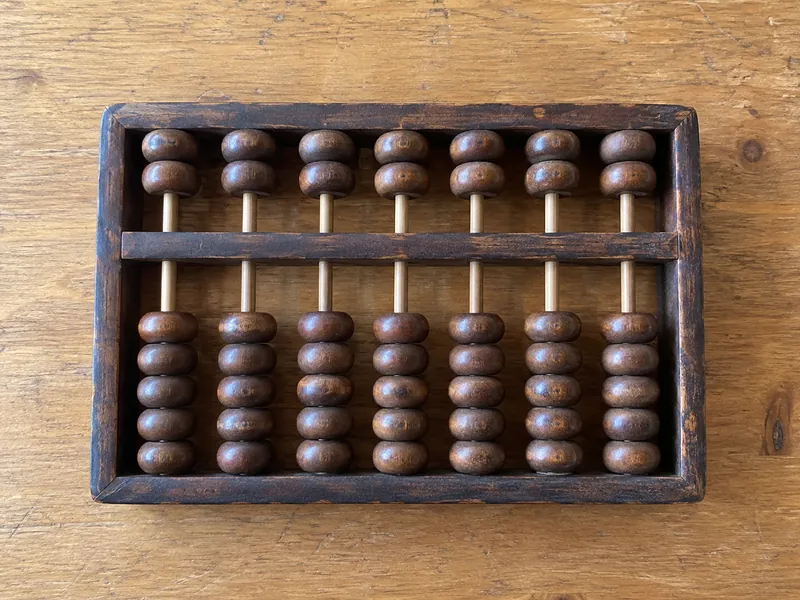
China
Suanpan
2 upper + 5 lower
Upper bead: 5 · Lower bead: 1
Vertical rods and a dividing beam; a traditional layout with extra beads for calculation procedures.
Japan
Soroban
1 upper + 4 lower
Upper bead: 5 · Lower bead: 1
Vertical rods and a dividing beam; a compact arrangement for the decimal digits 0–9.
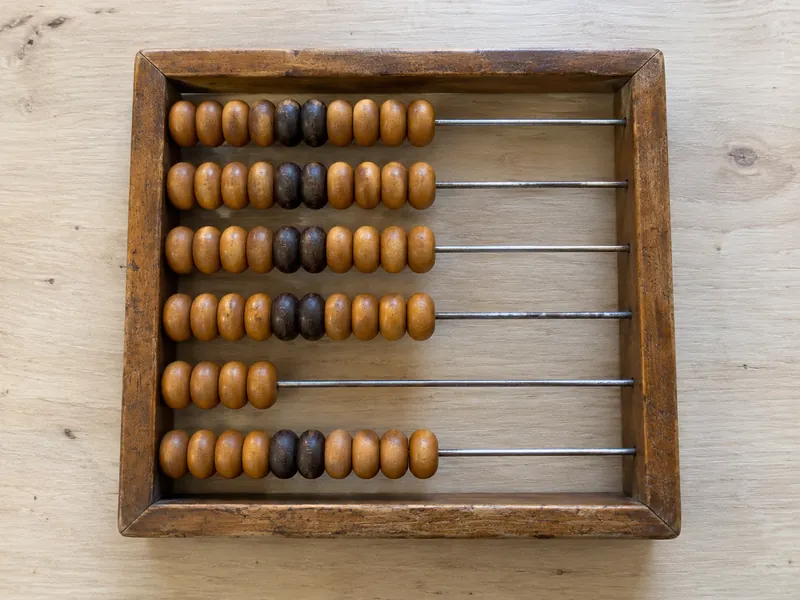
Russia
Schoty
10 beads on most rows
Place value changes by row
Horizontal wires without a dividing beam; some examples include a four-bead fraction row.
Interesting facts about the abacus
- An abacus needs no electricity: the user supplies the movements and the calculation rules.
- A Ming-era suanpan in the British Museum has a porcelain frame rather than the more familiar wooden one.
- The modern soroban needs only five beads per place to represent all ten decimal digits.
- An empty place can represent zero without requiring a separate “zero bead.”
- UNESCO’s recognition concerns the practice of Chinese zhusuan, not merely an object in a museum.
Frequently asked questions
Who invented the abacus?
No single inventor is known with certainty. The abacus developed through different traditions of counting surfaces, movable counters, and bead frames.
How old is the abacus?
Counting-board traditions reach back to antiquity, so the broad history spans more than two thousand years. Different bead-frame designs are later developments; there is no securely established birthday for the whole family of tools.
Where did the abacus originate?
Its precise origin is debated. Early counting surfaces are associated with the ancient Near East and Mediterranean world; the Chinese suanpan and Japanese soroban have their own later histories.
What is the difference between an abacus and a Soroban?
Abacus is the general name for a family of counting tools. A soroban is the Japanese bead abacus, whose modern form has one upper bead and four lower beads on each rod.
Is the abacus still used today?
Yes. Physical abacuses are used in arithmetic teaching and mental-calculation training, while digital versions offer interactive practice. Zhusuan also remains a living cultural tradition.