Before a dedicated counting board
Fingers, tally marks and small objects provide different kinds of help. Fingers make a small quantity immediately visible; a tally preserves a count after the objects have gone; loose stones can be regrouped during a calculation. These are related tools, but their purposes are not identical.
A pile of stones becomes inconvenient when the quantity grows. Marking positions on a surface changes the problem: one stone can represent a larger group because of where it is placed. The value belongs to the position as well as to the object. This is the central insight behind many counting boards.
Descriptions of sand or dust boards suggest how temporary calculation surfaces could work. Such surfaces leave little material evidence. A possible reconstruction of an early technique should therefore be distinguished from a surviving, securely identified object.
How counting stones make arithmetic manageable
Imagine a teaching board with a units area and a tens area. Three stones in tens and six in units represent 36. To add 17, add a ten and seven units. The units now total thirteen; exchange ten of them for one ten. The result is five tens and three units, or 53.
The stone itself has not changed. Its new position carries the larger value. A subtraction can reverse the exchange: one ten becomes ten units when there are not enough units to remove. This example explains the principle, rather than reconstructing the rules of every ancient board.
A modern reconstruction of the idea
36 + 17 → 4 tens + 13 units → 5 tens + 3 units = 53. Different historical boards used their own markings and conventions.
Greek calculation and the Salamis board
Greek counting-board traditions used counters on marked surfaces. The marble board associated with Salamis is an important surviving example. Its lines and numerical markings make it different from a modern soroban: it was a working surface, rather than a frame with beads fixed to rods.
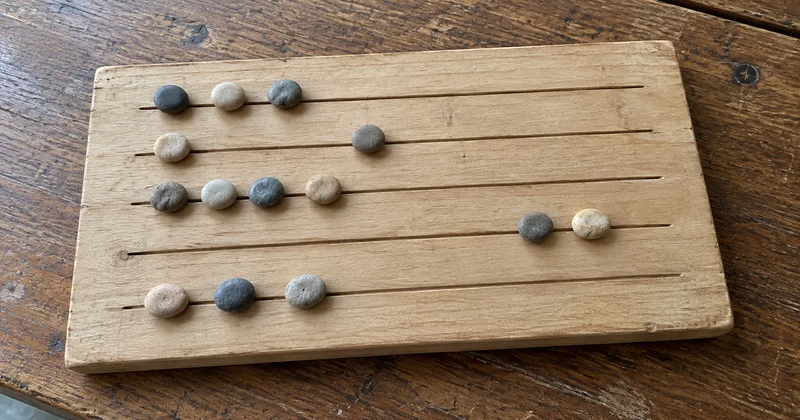
A historical board should be read within its own number and monetary systems. It is tempting to label every line “ones, tens, hundreds” in a modern illustration, but that would imply an exact interpretation of the original object. The image on this page shows a modern reconstruction of a generic ruled surface, with no claim to reproduce the Salamis board.
Roman grooves, five-values and fractions
Roman calculation also used portable hand abacuses with counters retained in grooves. On some designs, four lower counters and one upper counter represented a decimal place, with the upper counter standing for five. Additional positions served fractional calculations.
Captive counters offered a practical advantage: they could be moved without being scattered across a table. Writing Roman numerals and calculating with a device were separate activities. A difficult-looking written numeral did not require a calculator to manipulate its letters at every arithmetic step.
Museum displays sometimes include later replicas of Roman instruments. For example, the Science Museum Group catalogues replicas made in 1974. That date belongs to the replica, not to the ancient design. Distinguishing originals, reconstructions and teaching diagrams is part of responsible history.
What the evidence tells us
Ancient calculation tools helped people organize quantities for trade and other practical tasks. They also show that arithmetic need not be entirely written: a working arrangement can hold intermediate results while the user chooses the next operation.
The surviving evidence establishes several traditions, not a single uninterrupted family tree. Similar arrangements in distant places do not by themselves prove that one device was copied from another. The safest conclusion is that moving counters was a powerful idea with many adaptations.
Interesting facts about the abacus
- A counter can change value when it moves to another position.
- A portable abacus need not have rods: Roman examples used grooves.
- A modern replica is evidence of a reconstruction, not an ancient object.
- There is no securely identified single inventor for this family of tools.
Sources & further reading
The historical claims in this article are supported by the following museum records and research. Dates of surviving objects are distinguished from dates of invention.
- Whipple Museum, University of CambridgeA Brief History of Calculating Devices
- The League of Japan Abacus AssociationsHistory of the Soroban
- Science Museum GroupRoman hand abacus replicas (1974-487)