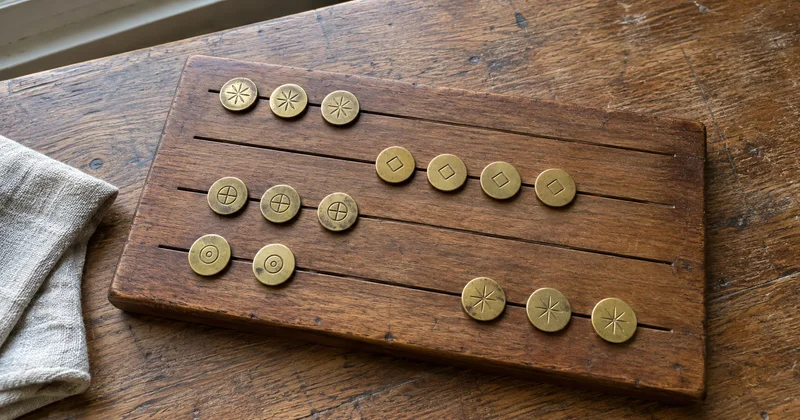
Boards, cloths and reckoning counters
A calculation surface might be a board, a marked table or a cloth. Lines or spaces gave counters their values. Specialized reckoning counters are often called jettons; German examples are also known as Rechenpfennige. These tokens were tools for arithmetic, even when their appearance resembled coins.
The distinction matters. A merchant could compute a large amount with inexpensive counters because their position represented the amount. There was no need for every token to be a valuable coin. The surface and its conventions supplied the numerical meaning.
How a merchant could work through an account
A practical calculation has several stages: identify the quantities, place the starting amount, add or remove counters, simplify the arrangement, and record the result. A second person could inspect the arrangement or repeat the calculation to check it. The board supported the working process, while the written account kept the outcome.
For a simple decimal teaching example, combine 24 and 18. Two tens and four units meet one ten and eight units. Twelve units become one ten and two units, leaving four tens and two units: 42. The exchange is the same mathematical idea as carrying in written addition.
This example is deliberately modern and decimal. A real account could involve several currencies or subdivisions, so its correct exchange rules depended on the units being used. A medieval merchant’s entire method cannot be inferred from a generic diagram.
An illustrative money exchange
Under the historical English relationship 12 pence = 1 shilling, 8 pence + 7 pence becomes 1 shilling and 3 pence. The exchange factor comes from the currency, not from the number of tokens.
Why counting boards suited commerce
Accounts often contain repeated additions, payments to subtract, and quantities expressed in different units. A movable-counter arrangement can be amended without rewriting every intermediate line. That makes the board a useful workspace for calculation rather than a permanent record.
Handling tokens also makes an exchange visible. Removing a group from one position and adding a token elsewhere displays a relationship between units. Accuracy still depends on the user: placing a token in the wrong space or using the wrong conversion can change the total.
What historical examples show
The British Museum holds an English brass reckoning counter dated 1307–1327. It provides a concrete medieval example of the object type. Its date documents that particular counter, rather than the first invention of reckoning with tokens.
A separate British Museum counter of the Rechenmeister type depicts counters being used on a board or table. Such imagery helps explain an object’s purpose. Later production in Nuremberg also belongs to this story, but early modern examples should not all be described as medieval.
The Rechenmeister object is catalogued as 1936,0412.1. That registration number identifies the museum record; it is not a claim that the counter was made in 1936. A museum record and its image can help establish an object’s material and purpose without turning an accession number into a historical date.
From counters to written arithmetic
Written arithmetic and counter reckoning coexisted. As methods using Hindu-Arabic numerals spread, a person could learn to calculate on paper while familiar counting practices continued. There was no single day when all European merchants abandoned their boards.
A board and a written algorithm solve similar problems with different kinds of workspace. On a board, position holds the value; on paper, written digits and their places preserve the steps. Seeing both methods helps explain the transition without portraying earlier users as incapable of sophisticated calculation.
Interesting facts about the abacus
- A jetton could resemble a coin without functioning as money.
- The same counter could stand for different values in different positions.
- A cloth could provide a calculation surface as well as a wooden board.
- A board’s result still needed to be recorded if the arrangement was cleared.
Sources & further reading
The historical claims in this article are supported by the following museum records and research. Dates of surviving objects are distinguished from dates of invention.
- British Museum · Google Arts & CultureBrass reckoning counter, Rechenmeister type (1936,0412.1)
- British MuseumEnglish brass reckoning counter, 1307–1327 (S.6)
- Royal Mint MuseumPounds, Shillings and Pence