The earlier tradition of counting rods
Chinese mathematicians used arrangements of counting rods before the familiar suanpan became widespread. Rods placed on a surface could represent numbers and participate in calculation. The bead frame inherited the broader principle of organizing a calculation through position.
A frame offers a different practical experience from loose rods. The counters remain attached, the places are arranged consistently, and the working state can be changed with a few movements. These advantages help explain its usefulness without establishing one exact invention date.
The suanpan in the Ming setting
The suanpan was well established in Ming China. Trade and administration required repeatable calculation of quantities and accounts, and bead arithmetic formed part of that practical world. Published calculating traditions also helped preserve and transmit methods.
A porcelain frame in the British Museum is dated approximately 1522–1566. Its elaborate decoration reminds us that a calculating object could be both useful and carefully crafted. The surviving frame is evidence for that period; it does not identify the first suanpan or its inventor.
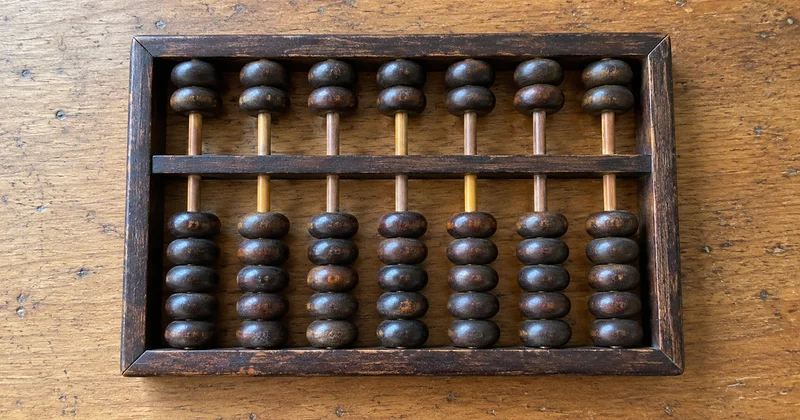
The museum’s object number is 1909,0611.1. Its porcelain frame has underglaze-blue decoration and holes for the rods along the inside walls. The surviving object is a porcelain frame, rather than an intact bead arrangement. The wooden suanpan image on this page explains the general design; it does not reconstruct this porcelain object.
Reading the traditional two-and-five layout
Each rod in a traditional suanpan has two upper beads and five lower beads, divided by a horizontal beam. On a chosen units rod, each lower bead counts as one and each upper bead as five. Only beads moved toward the beam contribute to the displayed number.
Move to the next higher place and the values are multiplied by ten: a lower bead there represents ten and an upper bead fifty. A further rod can represent hundreds. The units position is chosen for the calculation, so the same frame can also display decimal fractions.
Extra beads make some temporary and alternative representations possible. One upper bead and five lower beads have a combined value of ten in their place; a decimal calculation can exchange that value for one lower bead in the next place. The physical capacity of a rod is not the same as a finished decimal digit.
A worked example: 28 plus 7
Choose adjacent tens and units rods. Represent 28 with two lower beads in tens, then one upper bead and three lower beads in units. To add seven, think of it as ten minus three. Add one ten, then remove the three active lower units beads. The remaining upper units bead represents five.
The final arrangement is three tens and five units: 35. This example emphasizes an exchange that can be explained numerically. Traditional schools may teach particular finger movements and verbal formulas; the arithmetic relationship remains 28 + 10 − 3.
Read the places before reading the total
Tens: 2 → 3. Units: 8 → 5. Therefore 28 + 7 = 35. An upper bead in units means 5; the same bead in tens means 50.
Chinese Zhusuan and UNESCO’s 2013 recognition
The Chinese practice of bead calculation is known as zhusuan. Its cultural value includes the teaching, procedures and accumulated knowledge that make the instrument useful. A frame without an understanding of its rules is only part of the tradition.
UNESCO inscribed Chinese zhusuan in 2013 as intangible cultural heritage. That recognition concerns a living practice rather than an assertion that China invented every form of abacus. It also connects the historical instrument with teaching and cultural transmission today.
The recognition concerns knowledge and practices passed between people: learning bead positions, carrying out operations and teaching the method. Cultural heritage recognition is different from scientific evidence about educational outcomes. The controlled mental-abacus trials discussed elsewhere in this history library address those outcomes separately.
Interesting facts about the abacus
- A traditional suanpan has seven beads per rod, split into two and five.
- An upper bead is worth five lower beads in the same place.
- Porcelain frames existed alongside the familiar wooden form.
- Zhusuan names a practice of calculation, while suanpan names the instrument.
Sources & further reading
The historical claims in this article are supported by the following museum records and research. Dates of surviving objects are distinguished from dates of invention.
- Frank J. Swetz · Mathematical Association of AmericaReflections on Chinese Numeration Systems: Transition to the Abacus (2022)
- British MuseumPorcelain suanpan, Ming dynasty (1909,0611.1)
- UNESCO · Intangible Cultural HeritageChinese Zhusuan (inscribed in 2013)