Arrival from China and adaptation in Japan
The Japanese soroban developed from Chinese bead-abacus traditions. Accounts of the earliest arrival differ in their timing and detail, so a precise first-import date should not be treated as settled. By the later sixteenth century, surviving evidence documents the instrument in Japan.
The important development was the combination of an instrument with usable methods. A person needed to know how to choose places, set a number, carry values and perform the operations. Japanese users adapted both the physical form and the calculating procedures.
Calculation in the Edo period
During the Edo period, merchants, farmers and mathematicians used the soroban. A merchant’s account and a mathematician’s problem could have very different purposes, yet both needed reliable numerical work. The instrument offered a shared practical foundation.
Research on the Taisei Sankei examines historical soroban arithmetic through a mathematical work compiled by Seki Takakazu and the Takebe brothers. This is evidence for particular techniques and problems, rather than a reason to assume that every Edo learner followed the same curriculum.
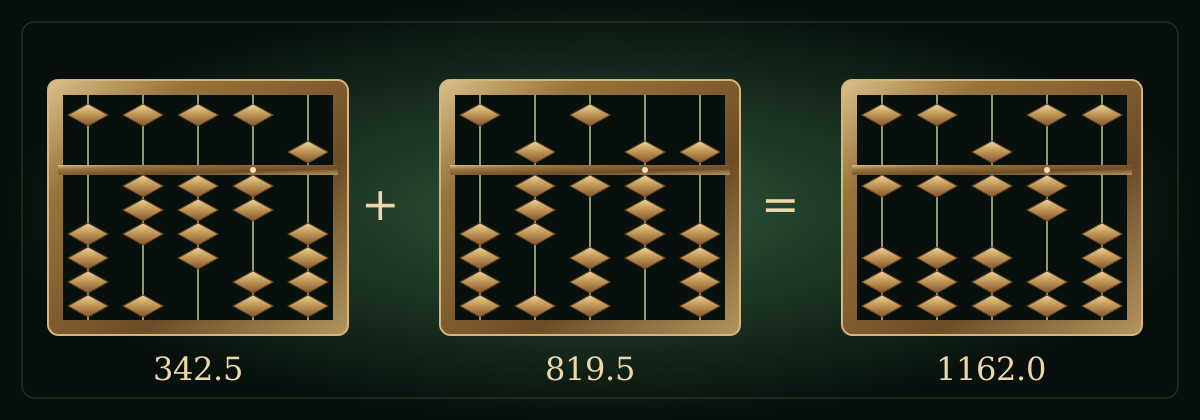
Rosalie Joan Hosking, Tsukane Ogawa and Mitsuo Morimoto explain procedures from the opening books of the Taisei Sankei in their 2018 Convergence article. The work was compiled between 1683 and 1711. Their discussion adapts procedures from an older two-upper, five-lower frame to a modern soroban; the illustration below follows that educational approach rather than claiming to show the original instrument.
One addition problem combines 342.5 and 819.5. Start with 342.5 and add the second number place by place. Adding 800 can be done as adding 1,000 and removing 200. Adding ten changes four tens into five tens: engage the upper five-value bead and release the four lower beads. Adding nine uses the complement of ten: add ten and remove one.
Finally, five tenths plus five tenths become ten tenths. Clear that place and add one unit. The intermediate totals are 1,142.5, 1,152.5 and 1,161.5; the final result is 1,162. These exchanges show why knowledge of five and ten complements mattered: a calculation could continue even when a place did not have enough free beads for a direct move.
Books helped make arithmetic teachable
Printed arithmetic books helped readers learn procedures through explanations and examples. Yoshida Mitsuyoshi’s Jinkōki, first published in 1627, is an important example in the history of Japanese arithmetic. A book could bring practical calculating problems into a form that teachers and learners could revisit.
Turning bead movement into a lesson requires a clear sequence. A teacher can show a number, ask the learner to identify each place, then explain an exchange before practicing it. This connection between representation and procedure helps explain the soroban’s educational appeal beyond its usefulness in accounts.
Why older sorobans look different
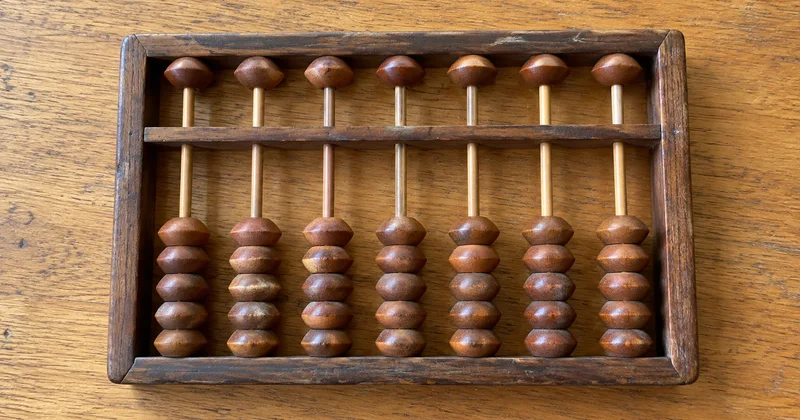
Historical Japanese instruments did not all use today’s five-bead arrangement. Designs included two upper and five lower beads, and later one upper and five lower beads. A museum object with six beads on each rod should therefore not automatically be mistaken for a damaged modern soroban.
The modern form has one upper bead and four lower beads. This is enough for every decimal digit: the lower beads show zero to four, and adding the upper five produces five to nine. The gradual spread and educational standardization of this arrangement belongs to the next period in the series.
One place, two useful groups
To show 6 on a modern units rod, move the upper bead and one lower bead to the beam: 5 + 1. On the tens rod the same arrangement means 60.
From practical arithmetic to an educational tradition
The soroban made a learner’s calculation observable. A teacher could see the represented number, notice a mistaken place and ask the learner to explain the next movement. Learning a fast procedure could therefore be combined with learning what the procedure meant.
Its history also shows why teaching traditions matter as much as an object’s shape. A smaller frame or fewer beads does not teach someone to calculate automatically. Practice, explanation and agreed methods turn the material instrument into a skill.
Interesting facts about the abacus
- Soroban is the Japanese name for the bead abacus.
- Edo calculation included both practical accounts and mathematical problems.
- Older Japanese instruments can have more beads than modern ones.
- Jinkōki belongs to the history of arithmetic teaching, not the invention of the abacus.
Sources & further reading
The historical claims in this article are supported by the following museum records and research. Dates of surviving objects are distinguished from dates of invention.
- Hosking, Ogawa & Morimoto · Mathematical Association of AmericaHosking, R. J., Ogawa, T., & Morimoto, M. (2018). Elementary Soroban Arithmetic Techniques in Edo Period Japan. Convergence, June 2018. DOI: 10.4169/convergence20180601.
- Japan Soroban Museum · National Federation of Abacus EducationHistory of the Soroban: books, schools and competitions
- The League of Japan Abacus AssociationsHistory of the Soroban