A gradual change, not one invention day
Older soroban layouts continued in use while simpler arrangements appeared. The late nineteenth and twentieth centuries are a useful period for following the spread of the modern design, but appearance, widespread adoption and official standardization are different events.
The Whipple Museum catalogues a Japanese instrument with one separated bead and five other beads per rod. Its record does not assign a secure manufacture date. It demonstrates the existence of an older layout without allowing us to date every stage from that one object.
Why one upper and four lower beads are sufficient
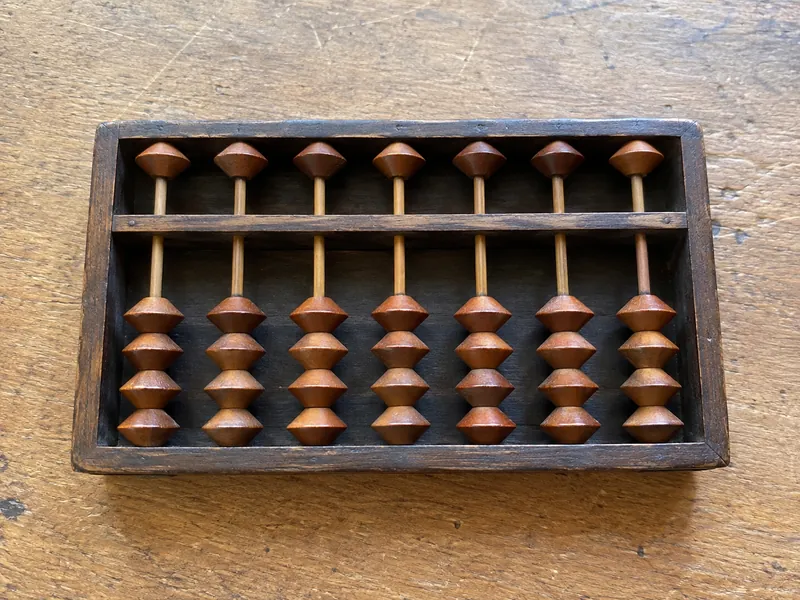
A decimal place needs to express the digits zero through nine. Four lower beads provide zero to four; one upper bead worth five extends the range to five through nine. A value of ten moves to the next place instead of remaining as a final digit on the same rod.
The earlier one-upper, five-lower arrangement could hold an extra lower unit. Removing that bead changes the physical capacity without removing a decimal digit. The user still has to perform the exchange between places correctly; a compact design does not carry automatically.
A dividing beam, consistently spaced rods and beads that are easy to grasp support repeatable movements. These are features a learner can inspect directly. They also explain why visual similarity alone is not enough to identify an old instrument’s date or regional origin.
The boundary between nine and ten
9 is one upper bead plus four lower beads in units. Adding 1 clears the units and activates one lower bead in tens. The number of beads is smaller, but the represented number is larger.
School arithmetic and a common layout
The Japan Soroban Museum’s chronology records the adoption of bead arithmetic in elementary schools in 1873 and an instrument adapted for visually impaired users in 1881. These nineteenth-century developments show that teaching and accessibility were part of the story alongside changes in bead count.
The Japan Soroban Museum records the adoption of the one-upper, four-lower arrangement as an educational standard in 1938. The Japan Abacus League also associates that year with soroban instruction in national arithmetic textbooks. This is a documented school milestone, not proof that no such layout existed earlier.
A common layout makes it easier to align diagrams, instructions and learners’ instruments. When teacher and pupil see the same arrangement, a movement can be described without first explaining extra beads. The educational benefit of a standard is consistency rather than mechanical automation.
Proficiency tests and calculation competitions
The Japan Abacus League dates the start of its soroban proficiency-test tradition to 1928. The Japan Soroban Museum records the first nationwide soroban competition in 1936. These developments made calculation skill something that could be practiced, assessed and compared in an organized setting.
A proficiency assessment and a contest have different purposes. One can recognize a level of skill; the other can rank performances under common conditions. Speed is meaningful only alongside accuracy and an agreed set of tasks. A famous result on selected calculations cannot prove that an abacus is faster than every calculator on every problem.
A changing role alongside electronic calculators
The expansion of electronic calculating tools changed the practical role of hand calculation. A machine can handle routine computation while a soroban lesson concentrates on representation, exchanges and practiced methods. One tool’s convenience does not erase the educational or cultural uses of the other.
This distinction explains the modern legacy. The soroban’s place in education and organized practice can continue even where commercial arithmetic is mostly electronic. The next article looks at how that learning works today, including digital bead tools.
Interesting facts about the abacus
- Five beads are sufficient to represent all ten decimal digits in one place.
- Standardizing an instrument is different from inventing its first example.
- The soroban does not perform a carry automatically.
- A competition result applies to its tasks and conditions, rather than every possible calculation.
Sources & further reading
The historical claims in this article are supported by the following museum records and research. Dates of surviving objects are distinguished from dates of invention.
- The League of Japan Abacus AssociationsHistory of the Soroban
- Japan Soroban Museum · National Federation of Abacus EducationHistory of the Soroban: books, schools and competitions
- Whipple Museum, University of CambridgeJapanese soroban with six beads per rod (6882)
- Whipple Museum, University of CambridgeA Brief History of Calculating Devices