Make place value visible before chasing speed
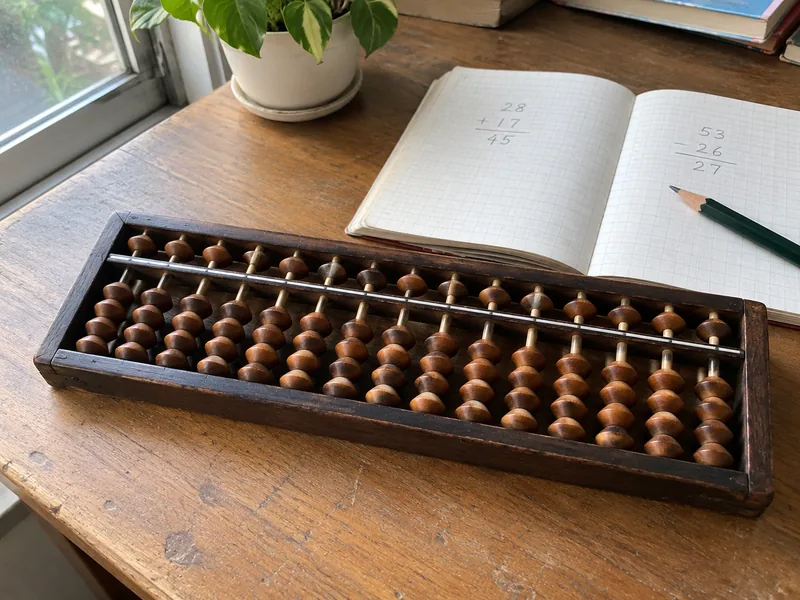
For a beginner, an abacus is a model of a number. The learner first identifies the units place, reads the active beads and explains what adjacent rods mean. Moving a single bead in tens changes the total by ten, while the same movement in units changes it by one.
An exchange can then connect the model to written arithmetic. To add one to 19, the units become zero and the tens become two. Asking the learner to explain this change teaches more than asking for a quick answer. Fluent movements are useful, but meaning gives them a foundation.
Explain an exchange
19 + 1 = 20. Why do the units clear? Ten units are exchanged for one ten. The tens increase from 1 to 2; the units become 0.
What mental abacus arithmetic involves
Mental abacus arithmetic uses an internal representation of bead positions. The learner practices changing that representation according to familiar arithmetic procedures. It differs from simply recalling a stored answer, because the represented number is updated through the calculation.
A practical learning sequence can alternate physical work with short visualization tasks. Represent a number, describe its beads, look away and explain a small change, then check on the real frame. Difficulty should follow the learner’s understanding; an unclear mental image is a reason to return to a visible model.
What research supports—and what it does not
A three-year randomized study published in 2016 found an arithmetic advantage for students trained in mental abacus, without improvement in basic general cognitive abilities. A shorter classroom-randomized study, published in 2018, did not find a general advantage in mathematical computation.
These findings support a measured approach. Training length, the learning setting and individual readiness matter. They do not justify promises that a short course will universally increase intelligence or guarantee exceptional calculation speed. A useful aim is demonstrable progress in the arithmetic being practiced.
What digital bead tools can offer
A digital abacus can make the same structure available without carrying a physical frame. Visible rods, a dividing beam and responsive beads allow learners to set numbers and inspect exchanges. A displayed total can help check a result, provided the learner also understands how to read the beads.
Different tools serve different tasks. A guided lesson can introduce an exchange; a free board can support exploration; flash cards can practice recognizing bead patterns. Alternating these tasks helps avoid confusing recognition of a number with the ability to calculate with it.
The instrument should support the lesson rather than supply all the thinking. One useful exercise is to predict the new number before moving a bead, then explain any disagreement with the displayed total. This works with physical and digital tools alike.
How learning keeps the tradition alive
The ongoing tradition includes teachers, learners, makers and people who practice together. Chinese zhusuan’s UNESCO inscription in 2013 recognizes transmitted knowledge and practices, reminding us that the instrument’s history continues through use.
A learner need not become a competition calculator to find value in it. Reading a number confidently, understanding a carry and explaining a subtraction are meaningful skills. Sorobak’s public lessons, online abacus and flash cards offer ways to explore those tasks without registering.
Interesting facts about the abacus
- A mental abacus is a learned representation, not a physical device inside the head.
- Recognizing a bead pattern and performing a calculation are different skills.
- Digital tools can show a total, but the learner still needs to understand place value.
- No account is needed to read these articles or use the public lessons.