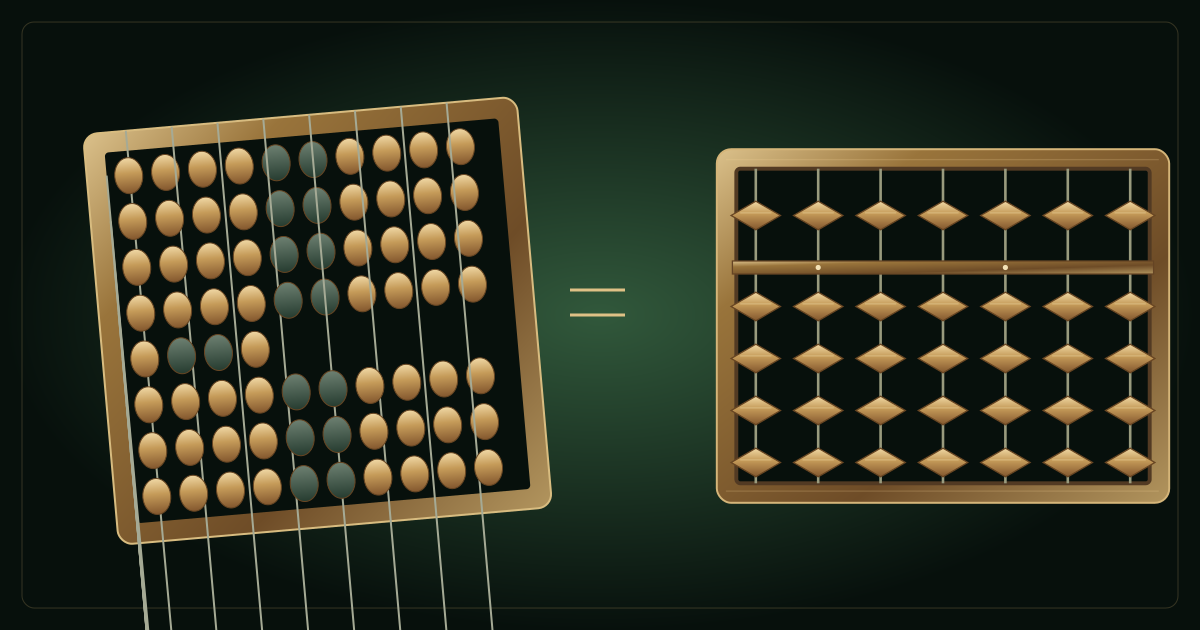
Horizontal wires and equal-value beads
Schoty are held with their wires running across the frame. Most rows have ten beads, and all the beads on a given row have the same value. There is no dividing beam separating a five-value bead from one-value beads. An adjacent decimal row changes the value represented by a bead.
The Smithsonian’s overview distinguishes this arrangement from the vertically organized Chinese and Japanese instruments. Some Russian examples include a row with fewer beads for fractions. The number and purpose of rows should be checked on the particular instrument before assuming every wire is a consecutive whole-number place.
How a decimal exchange works
For a teaching example, choose two ten-bead rows as units and tens, and agree that beads moved to the left are active. Two active beads in tens and seven in units represent 27. Adding five units fills the units row with ten beads and leaves two more units to add.
Return the ten unit beads to their inactive side and activate one additional ten. Then activate the two remaining units. The result is three tens and two units: 32. The row can physically hold ten active beads, but a completed decimal representation exchanges that ten into the next place.
An illustrative calculation
27 + 5 → 2 tens + 12 units → 3 tens + 2 units = 32. This example uses selected decimal rows; it does not assign a value to every row of a historical object.
Accounts and fractional rows
The Russian abacus belongs to the practical history of hand calculation and accounts. A frame can keep an amount visible while a user adds a payment or subtracts an expense. It is a workspace: if the beads are cleared, the result needs a separate record.
A four-bead row is often associated with quarter-unit reckoning. Its place and use depend on the instrument’s conventions, including monetary ones. Four beads do not make it an ordinary decimal digit row. Describing a fractional row carefully is more useful than treating every Russian abacus as an identical modern teaching board.
A documented Smithsonian example
The National Museum of American History catalogues an object titled “Tchoty, or Russian Abacus,” record nmah_690536, accession 1988.0489.01. It has eight metal rods in a wooden frame, with plastic beads. Seven rows each contain ten beads; the fourth row from the bottom contains four.
The collector George W. Sims purchased this instrument in August 1965. Notes on its box identify Smolensk as its origin. This documents one twentieth-century instrument, rather than the beginning of the Russian counting tradition. The original diagram here explains its broad arrangement and is not a photograph or a replica of the museum object.
Schoty and Soroban compared
On a modern soroban, each vertical rod has four lower one-value beads and one upper five-value bead. Only beads moved toward the dividing beam count. On schoty, ten equal-value beads commonly share a horizontal row, with activity defined by the side to which they are moved.
Both instruments require the user to understand place value and perform exchanges. A bead count alone does not tell you the displayed number: you must identify the units position, active beads and any special fractional row. Neither device carries automatically like an electronic calculator.
| Feature | Russian Schoty | Modern Soroban |
|---|---|---|
| Organization | Horizontal rows | Vertical rods |
| Typical decimal place | Ten equal-value beads | One five-value bead and four one-value beads |
| Active position | An agreed side of the row | Toward the dividing beam |
| Fractions | Some instruments have a special row | Choose the units rod to represent decimals |
Interesting facts about the abacus
- All beads on a schoty row have the same value.
- Colored central beads can help the user see groups within a row.
- The Smithsonian example has a four-bead row among seven ten-bead rows.
- An acquisition or purchase date does not establish the invention date of the instrument type.
Sources & further reading
The historical claims in this article are supported by the following museum records and research. Dates of surviving objects are distinguished from dates of invention.
- Smithsonian · National Museum of American HistoryTchoty, or Russian Abacus (nmah_690536)
- Smithsonian · National Museum of American HistoryThe Russian Abacus · The Abacus and the Numeral Frame
- Powerhouse CollectionSchoty, Russian abacus, c. 1950 (2010/1/160)